


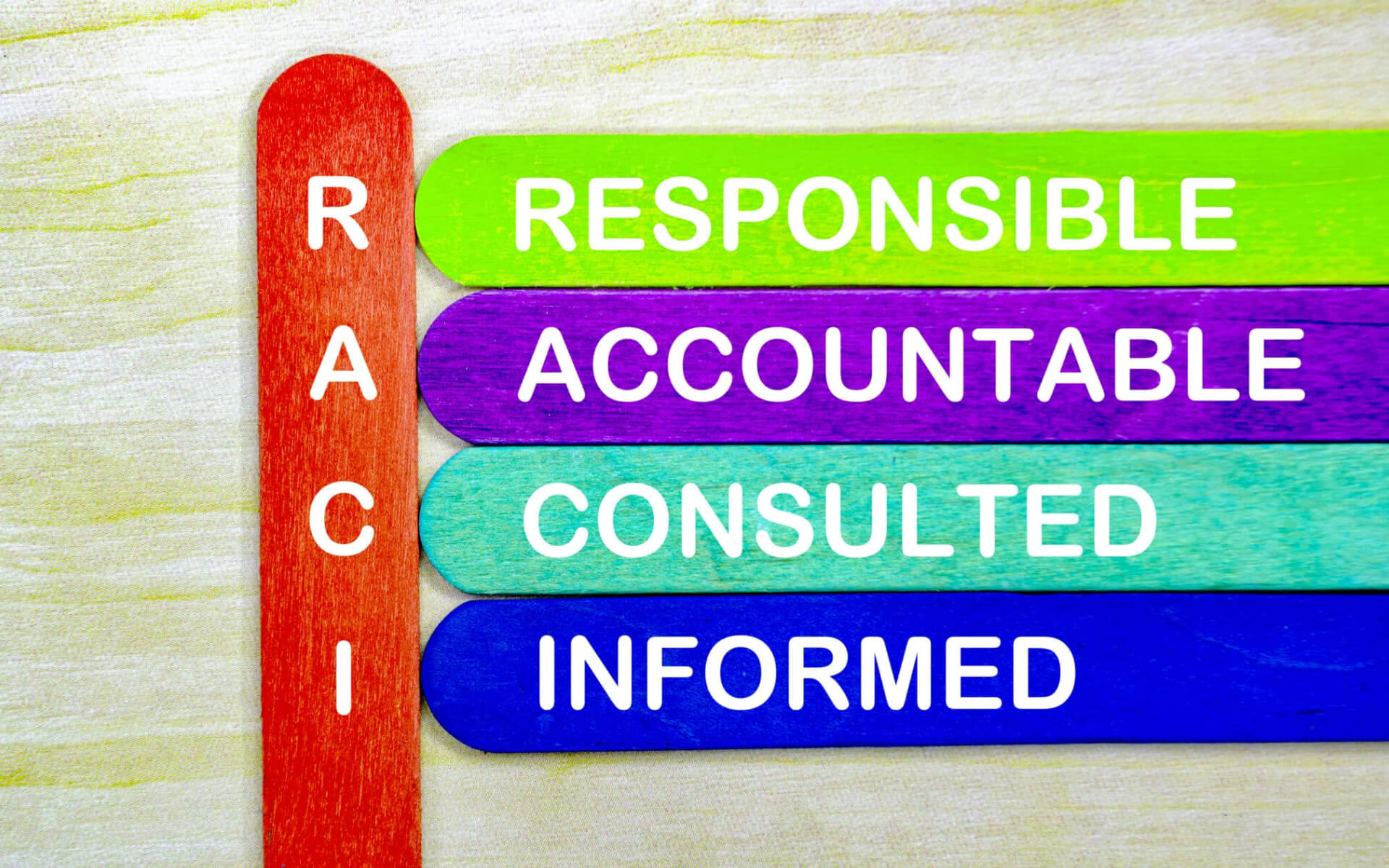
Seasoned Project Managers will be familiar with the RACI matrix. If you need a refresher, it’s a framework used to clarify roles and responsibilities on a project. Often in table format (spreadsheet), it cross-references tasks (usually at a high level) with the people involved. Each person is then assigned one of the RACI roles:
- R – Responsible
- A – Accountable
- C – Consulted
- I – Informed
Most project managers agree on at least one thing: every task should have only one “A” — the person ultimately answerable for the outcome. But when it comes to the “R” for Responsible, opinions start to diverge.
Responsibility – One or Many?
A common argument is that for some tasks, there is no single person who is responsible. After all, real work is often collaborative. But before assigning multiple Rs, it’s worth asking: What are you trying to achieve with your RACI?
If your goal is to track detailed work assignments, there are better tools for that — think Jira, Microsoft Project, or similar task management platforms. Those are tools for granular task tracking.
A RACI should provide role-level clarity. It should tell you, as the Project Manager, who is taking the lead. Who is the single point of ownership to ensure that work moves forward?
A Single “R” Provides Clarity
When multiple people are marked as Responsible, ownership becomes fuzzy. If everyone is responsible, it often turns out work does not get completed. Everyone thinks someone else is doing the work.
That’s why I advocate for a single-R rule. It helps answer one critical question:
Who do I go to when I need to check on progress, resolve a blocker, or escalate an issue?
Even in collaborative tasks, there’s usually one person who’s better positioned to take the lead. Assign that person the “R”, and reflect the supporting roles through “C” (Consulted) or other project tools.
What To Do If You Can’t Decide On One R
Sometimes, you genuinely can’t assign one person to a task. This is a clear indication that you need to decompose the task further.
Let’s say your RACI includes a task to “Replace kitchen dishwasher,” and both Ted and Sally are listed as Responsible. If you dig deeper, you might find Ted is the electrician, while Sally is the plumber. That’s really two distinct responsibilities. It should be two separate RACI line items.
It will increase the length of the RACI, but it’s the best way for total Clarity.
When Multiple “Rs” Might Still Work
Of course, there are exceptions. In fast-moving or highly collaborative environments, assigning multiple Rs might be ok. If the task truly requires shared effort with equal responsibility, or you have a very high functioning team with little risk of work being overlooked.
There’s no absolute rule. The key is to use RACI as a tool for clarity, not bureaucracy.
Final Thoughts
In my experience, sticking to one Responsible per task results in fewer delays, less confusion, and stronger ownership. But, like any framework, a RACI should be adapted to fit your team and your project.
Project management is a big part of how we communicate with clients. Want to learn more about how MERAK can work with you to update your processes? Check out: Business Modernization
Last Updated: May 22, 2026